

Charlie Cleverly
4 Dec 2025
What do a Cameroonian Rapper brought up in an African ghetto, an Austrian intellectual with an Oxford PHD in ‘genocide in the Bible’, an Italian grandson of a family with Mafia links, a Romanian former architect, and a bi-vocational Slovakian paramedic who airlifts the injured to hospital by helicopter… have in common?
They are all five of them now planting new, growing, beautiful indigenous churches in Europe – that most needy but potentially so fruitful continent. These churches are in Toulouse, Vienna, Amsterdam, Bucharest, and Bratislava. They have the aroma of Christ and his healing life about them. They are like many-faceted diamonds: attractional and hopeful signs in a continent that is changing before our eyes. They have grown from tiny beginnings to number between 100 to 300 people. They and many other of the 42 churches the Europe Collaboration supports are signs of a spiritual climate change in Europe.
Shifting Tectonic plates in Europe – and Spiritual Climate Change?
The Europe Collaboration (EC) has a vision to help in the re-evangelisation of Europe through the planting of new, Christ-like, helpful, holistic and healing Churches. Europe is a vast, sprawling and diverse mission field of 750m people. It has around 48 countries, many different cultures and languages. Within it, there are tragic challenges: war, migration, poverty, climate change – as well as some of the world’s richest and most influential countries.
In our time, the continent is experiencing a shifting of tectonic plates as the status quo for Defence, Aid, Migration, Social Care and Financial Markets groans with new uncertainties…
It is a disruptive time. But clearly, God is not dismayed: Jesus said: ‘I will build my Church’ and He is still doing so. His cry still rings out – maybe more clearly than ever. This beloved, varied continent of great beauty and need has become one of the major world focuses for Mission.
Today, the fact is, stories of a ‘Quiet Revival’ extend across Europe. For many this moment speaks of a vital inflexion – one that invites an investment of prayer, faith, and new churches into the harvest. The secularism that has become so deeply entrenched in the European psyche has, in recent years, begun to be found wanting. The Bible Society’s explanation for this is that Christianity offers, “an alternative to the individualistic, competitive, materialistic worldview that has come to dominate western societies in recent decades”[i]. I will give some statistics for this at the end of this article. EC has visited, partnered with, helped, and stood alongside so far 42 fascinating new churches across Europe’s varied landscape.

I hope I can convey the birth pangs, the excitement, the romance of seeing some of the ‘empty cradles of Europe, her churches, light up with a new generation of believers’. I want to give some dynamic snapshots – or ‘reels’ of what is happening in the hope that we may fall in love again with one of the things Jesus loves, His Church, His Bride who is making herself ready.
Highlight Reels from Five Fragile but Fabulous new Churches in Europe
Walking into the EC Toulouse community, named ‘La Rencontre’ (‘The Meeting’), is breath-taking: there is the buzz of expectation and hope – it is noisy – as suits a church led by a gifted Cameroonian former rapper, but it is super well organised as suits his brilliant French wife – a former health professional. It is a young, multicoloured and multicultural church for all nations. They meet over two morning services in a well-equipped rented space that was formerly a dance studio close to a metro stop. All these ‘venue stories’ are incidents of God opening unlikely doors. The ‘atmosphere of expectation’ story is also common to all these new churches, which comes from a history of the miracle of people finding faith in Christ, as well as from stories of healing and transformation into purposeful, wholesome living.
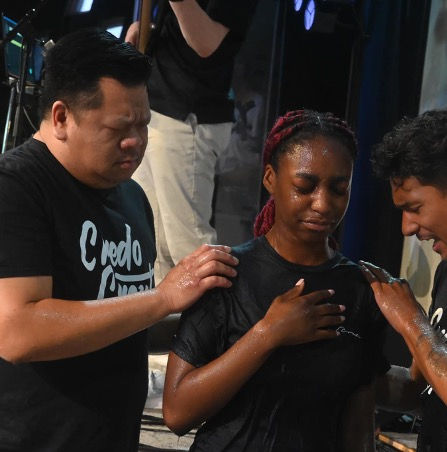
Amsterdam’s ‘Credo Church’ (pictured), led by Italian Enzo and Indonesian Sandy – both fluent Dutch speakers – tells many stories of new life for broken people in one of the poorest parts of the city. They meet in their own miraculous, spacious building with its meeting hall on the first floor to protect against Amsterdam’s floods. You can almost smell the aroma of Christ walking through the throngs of people gathering with expectation. The church has featured on the TV news locally as the city officials have taken an interest, wanting to help and partner with some of the midweek ministries serving some of the most fragile in the city.
Vienna’s ‘Citykirche’ is a more upmarket community of thinkers and professionals, led by an Austrian former full-time evangelist to the German-speaking world, skilled in apologetics. Meeting in a beautiful school hall with frescos (nicknamed by the church’s children the ‘Harry Potter School’). Their monthly ‘Big Questions with Q and A’ event is a popular place for people to invite friends who may be seekers after truth. The church has steadily grown with a vibrant but also liturgical style perhaps appropriate to this great city, once the very centre point of Europe.

M28 Church in Bucharest is led by a Romanian former architect with planning genius which shows in the building they have been able to adapt: they gather in two packed morning services with clear and compelling teaching from the Bible, which is like ‘heaven touching earth’. They recently travelled through tragedy with the funeral of the child of a young couple in the community, which matured and changed the church as only suffering can. All these churches embrace emotional intelligence in the face of suffering while holding on to the hope of heaven.
A final snapshot is of our Slovakian partner church in Bratislava. When war broke out in neighbouring Ukraine, the exemplary and gifted church leaders - crisis paramedic Tomas and his wife Silvia - immediately welcomed refugees into their home (plus their dog!) for a season as the new church – a haven of welcome – adjusted to the new reality of life in Europe.
Antioch Churches in Europe Again?
In these churches we see marks of community similar to those seen in the early Church at Antioch:
1. Transformation of People – often of those under 40 years old: these churches are young but very well organised in their seeking to make disciples out of converts.
2. Intelligent Communication of Bible Truths and the Teaching of Jesus, which connects with Culture.
3. The Atmosphere of Expectation and fruitfulness – often found in Prayerful Worship and Eventful Gatherings.
4. Deep love for the Poor and the Poor in Spirit.
5. Emotional intelligence including the capacity to cope with Suffering and Trouble. These churches are strong but at the same time fragile in that they are human as well as heavenly.

These marks are all found in the Church at Antioch which planted the first Church in Europe. There we see, in Acts 11 and 13: Many Conversions and Transformed Lives – a growing community (11v24). There is Brilliant teaching from Paul and Barnabas who nourished the Church (11v26). There was an atmosphere of Prayer and Worship crackling with expectancy where things happened – in Acts 13 (v1-3), for example, the call and sending out of Paul and Barnabas to Europe. There was prophetic, practical care for the poor in the climate disaster of famine in Jerusalem and the gift of money sent to the Church there (11v27-29). Lastly, the Antioch Church itself began in Suffering and the ‘scattering’ due to Persecution leading to the Church being able to creatively become multicultural and reach an entirely new people group, namely Greek-speaking inhabitants of that great city (11v19-20).
At the EC, we want to be involved with such churches, investing in them and helping bring them to maturity.
Shifting Spiritual Climate in Europe?
Today there is new evidence and hope for the renewal of Christian worship in Europe. In France, the number of evangelicals has increased strongly, from 650,000 to 1m in the past eight years. The Catholic Church reported an increase of 45% in the number of adults receiving baptism. This past Easter alone 18,000 mainly young people asked for this. Journalist Antoine Pasquier in his French language Inquiry into Why Young People Want to Become Christians, for those aged 15-25 in France, he found that Bible reading, more than social media and the internet, has been fundamental to large numbers of conversions among the young.
In the Netherlands and in Belgium, there is carefully documented growth. The climate is changing in Scandinavia too: in Finland, Norway and Sweden, those stereotypical bastions of European secularism, there are news reports detailing unlooked for growth.
In the UK, the change has become so significant it has been called the ‘Quiet Revival’, with increased church attendance across all age categories, especially young men. SPCK Publishing reported an increase in Bible sales – especially from Gen Z – from £2.69m in 2019 to £5.02m in 2024. We don’t have similar research yet for Eastern Europe, but our partners there do report some growth – for example, the two EC Churches in Bucharest who both report growing interest, conversions and transformation, particularly among young adults.
This merits careful attention. For a far fuller report on all the above trends, with footnotes pointing readers to original language articles, please see the accompanying EC article ‘A 'Quiet Revival' in Europe?’
Meanwhile, please pray for the remarkable leaders planting remarkable churches in this now fruitful landscape.
Charlie Cleverly
Advent 2025, Oxford.
Charlie and Anita Cleverly serve as Team Chaplains with Europe Collaboration. Before this role they led for ten years a French language Church in Paris which experienced rapid growth, before moving to lead St Aldates at the heart of Oxford UK, where they served for nearly 20 years.
[i] Bible Society